MixMapp – Event Platform
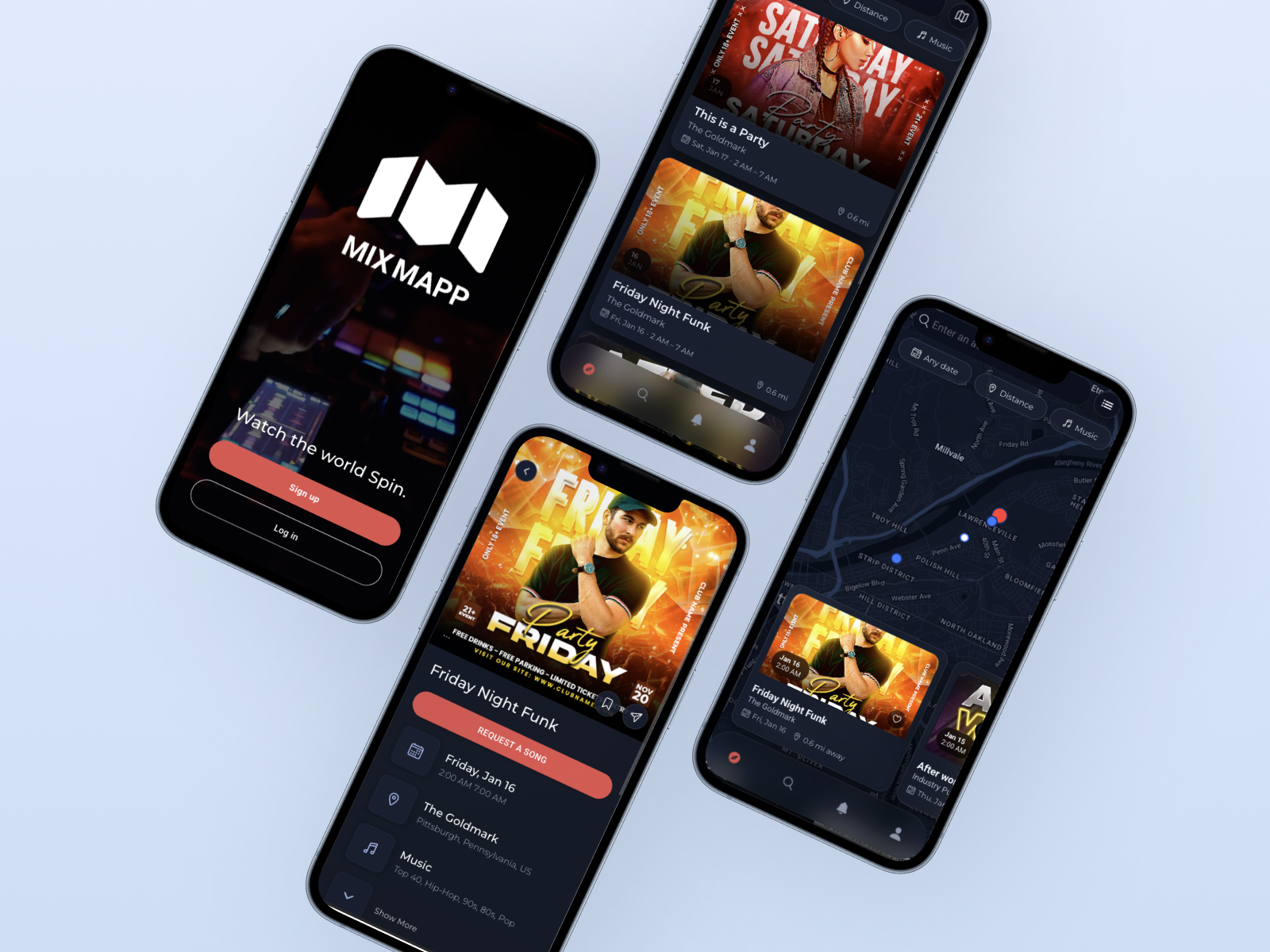
A mobile-first map experience that helps people find DJ-driven events nearby, filter by vibe, and interact with DJs through real-time song requests.
- Designed a map-first discovery experience with synced cards + markers.
- Created end-to-end flows for both guests and DJs, including event discovery, details, and song requests.
- Built the MVP in Angular & Ionic on a real backend (Supabase) to iterate quickly in code.
OVERVIEW
MixMapp is a mobile-first, map-based experience that helps people discover DJ-driven events nearby, decide quickly based on vibe, and interact with DJs through lightweight song requests.
Who it’s for
Guests who want to figure out where to go tonight, and DJs who want a focused way to publish events, promote a shareable page, and manage requests.
MVP scope
- Included: map browse, vibe filters, event detail, request a song, DJ profile, basic notifications.
- Not yet: ticketing, payments, chat, feed, advanced promoter tools, deep analytics.

ROLE / SCOPE
I owned MixMapp as the solo product designer and partnered with multiple engineers to build a working MVP—defining the scope, designing guest and DJ experiences, and validating the core interactions in code.
- Role: Sole product designer (UX/UI + product framing)
- Owned: end-to-end flows (Guest + DJ), IA, interaction rules, visual system, prototyping/testing
- Shipped/Validated: working MVP used for build-to-learn tests with DJs + friends
- Intentionally deferred: ticketing/payments, chat/feed, advanced promoter tooling, analytics
CONTEXT / CHALLENGE
Discovering DJ events is scattered across Instagram stories, flyers, group chats, and word of mouth. Guests often find out too late, and DJs don’t have a single, focused channel for showcasing where they’re playing tonight. Many event apps are either too broad (all event types) or built around ticketing. MixMapp targets the “night-of decision” moment: What’s happening nearby, right now, and what’s the vibe?
The challenge
- Show what’s happening nearby at a glance.
- Help guests decide fast based on vibe and music.
- Give DJs a lightweight way to promote sets and accept requests.

RESEARCH / DISCOVERY
Research was lean but focused, optimized for speed:
- Informal interviews with DJs and frequent nightlife-goers to understand current behaviors.
- Light competitive scan to identify gaps in map UX, filters, and interaction features.
- Quick flow sketches to align on the happy path: open app → see map → filter → tap event → request song.


DESIGN / SOLUTION
MixMapp helps people choose where to go in under a minute—scan the map, refine the vibe, and act without losing context.
- Design intent: “Make the night-of decision fast.”
- Core mechanic: “Map + bottom sheet list stays in sync.”
- Differentiator: “Real-time interaction via song requests.”


SIGNATURE INTERACTION: MAP + SHEET SYNC
The defining experience is the choreography between the map and the bottom sheet—so guests can browse options without losing spatial context. I iterated heavily in code to make the handoff feel immediate and “native.”
Result: users can scan multiple options in seconds—without losing where things are on the map.
Interaction Behaviors
- Tap marker - highlights the matching card + brings it into view
- Change filters - map + list refresh together (loading + empty states)
- Scroll list - focused pin updates to the centered card
- View event - opens details without losing your place on the map
- Engage - request a song in a lightweight flow
VISUAL SYSTEM / UI COMPONENTS
I used a dark, nightlife-inspired palette with high contrast for low-light legibility. The system is designed for fast scanning—time window, distance, and vibe tags first—with consistent patterns across map, list, and detail views.
- Consistent event card patterns across map/list/detail views.
- Thumb-friendly chips for quick filtering without leaving the map.
- Clear emphasis on the primary action on event detail (Request a Song).

DESIGN DECISIONS / TRADEOFFS

BUILD SNAPSHOT
I designed the UX and partnered with one engineer to ship a working MVP so we could validate “map + sheet sync” in real use.
- Client: Angular + Ionic
- Backend: Supabase (auth + data)
- Maps: provider for tiles + markers + location
- Why code mattered: interaction tuning (sync rules, loading/empty states, perceived performance)
TESTING & ITERATION
With a working prototype, I shared MixMapp with a small group of DJs and friends and iterated based on observation:
- Build-to-learn loops: Tested the working MVP with a small group of DJs + friends using real “night-of” scenarios.
- Observed, not just asked: Watched how people browsed the map/list, where they hesitated, and what they tried to tap first.
- Iteration focus: Tightened the map + sheet sync (marker highlight, centered card focus, tap-to-scroll behavior) to feel immediate and native.
- Reduced friction: Simplified the path from discovery / detail / request (fewer steps, clearer primary action, better defaults).
- Edge cases + states: Added/adjusted loading, empty states, and refresh behaviors so filters feel reliable and predictable.
- What I tracked: time-to-first-decision, filter usage patterns, request completion rate, and common drop-off points.
OUTCOMES / NEXT STEPS
- MVP is in active development with core flows implemented end-to-end.
- Early testing confirms the “decide fast” model: browse / filter / detail / request with minimal friction.
- Success metrics at launch: time-to-decision, filter usage, request completion, repeat sessions per user.
REFLECTION
MixMapp complements my enterprise work by sharpening fast product judgment, interaction craft, and build-to-learn iteration. I’m deliberately practicing tight scoping, real-world testing, and polishing the details that make an experience feel truly native.
My biggest takeaway: most event apps try to serve everyone, so they rarely feel tailored to anyone. MixMapp takes the opposite approach—intentionally specific to DJs and music-first nightlife decision-making—so the experience feels bespoke rather than generic.
The real work is in the choreography between map, list, filters, and actions. That’s where I focused both design and engineering effort to make MixMapp feel immediate, predictable, and usable.